
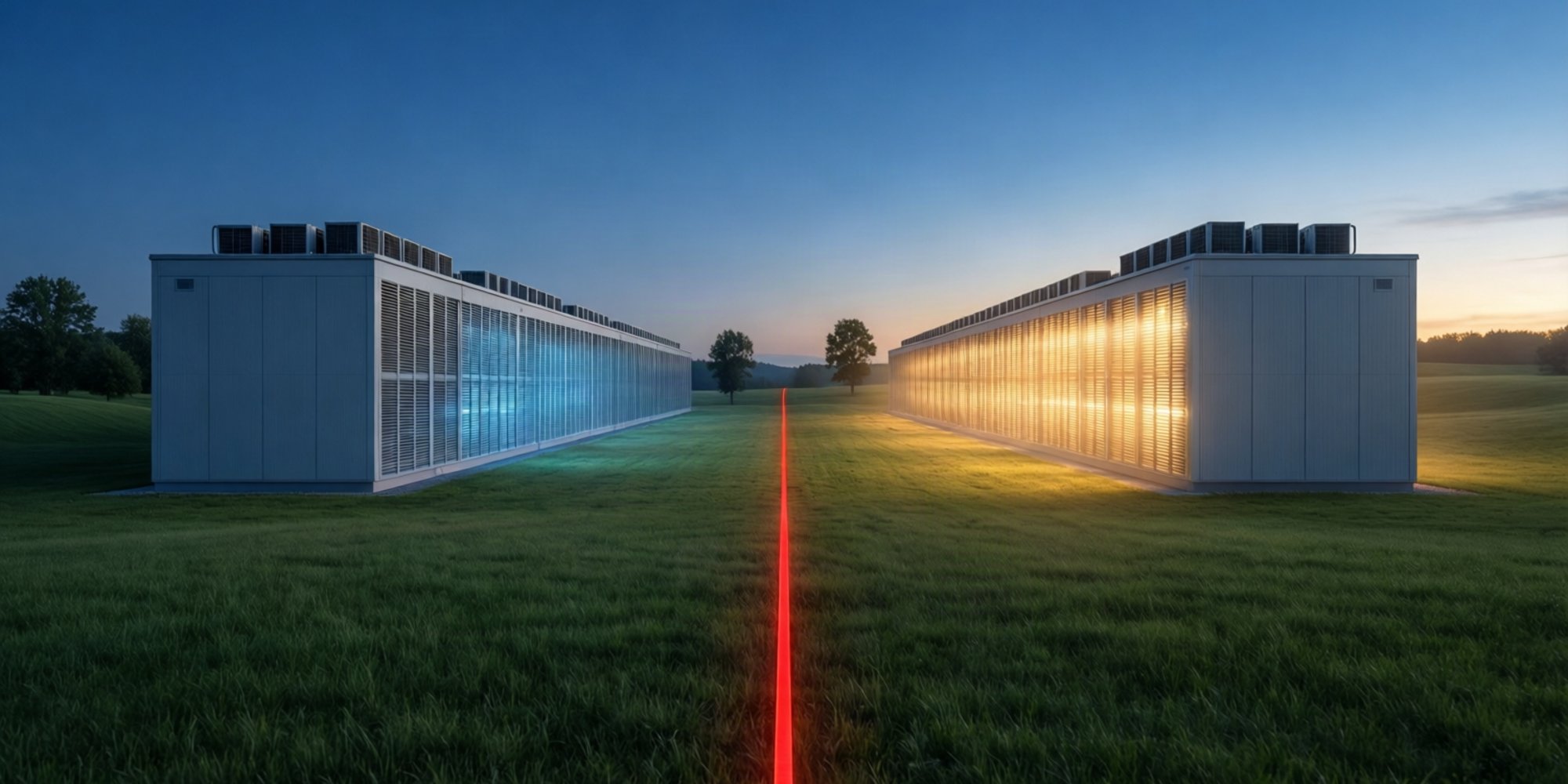
What happens when you are not the one who builds it first, and what it means for the buildings where it runs.
The Wrong Question About Super Intelligence
Most of the conversation about Super Intelligence asks one question: who gets there first.
It is a natural question. It is how the industry keeps score: who has the best model, the most chips, the most capital.
For almost every country on Earth, it is the wrong question, because almost every country will not get there first.
The better question is what they do about it. When that answer comes, it will not be aimed at an algorithm. It will be aimed at a building.
The term itself is now official vocabulary. On September 29, the President signed an executive order directing federal agencies to use “Super Intelligence” and “SI” in place of “Artificial Intelligence” and “AI,” and asking for proposed legislation to establish a federal definition within 60 days (The White House). In executive-branch usage, SI now covers the whole field.
This article is about the far edge of that field: the first system that outperforms the best human experts across the domains that decide national power, from intelligence analysis and cyber operations to weapons design and strategy. Super Intelligence of that kind might not be a nuclear weapon. But a country in control of one would hold a decisive advantage over every other country.
So what do you do when you are not the one who builds it first?
Red Lines Are Simple. They Can Also Be Deadly.
In foreign policy, a red line is a public statement with a simple shape: if you do this, we will act. Red lines can be simple. They can also be deadly. They have been drawn around chemical weapons, around missile deployments, around weapons programs and around borders.
A red line works when three things are true. The thing it guards against has to be visible. It has to be verifiable, so that both sides can tell whether the line has been crossed. And the response has to be credible.
The nuclear age taught the world to think this way. In July, we wrote about Mutually Assured Destruction and why compute has become the new strategic race. Deterrence held, in part, because the capability that mattered could be seen, counted and located.
Super Intelligence raises the next question in that sequence. If one country’s system could outthink every other government’s intelligence services, cyber defenses and planners, can every country be allowed to have one? The nuclear age answered a version of that question with nonproliferation: a small number of states holding the capability, a treaty structure around them, and inspections to verify it. Whether anything like that can work for Super Intelligence is now an open question in foreign policy.
The Red Line Is Already Being Drafted
Governments have not drawn this line yet. Others are drafting it for them.
In September 2025, a call launched at the United Nations General Assembly and backed by former heads of state, Nobel laureates and leading AI researchers urged governments to reach an international agreement on red lines for AI, with robust enforcement, by the end of 2026 (Global Call for AI Red Lines).
A sharper version comes from a 2025 strategy paper on AI and national security. It proposes a deterrence regime it calls Mutual Assured AI Malfunction, in which any state’s aggressive bid for unilateral AI dominance is met with preventive sabotage by its rivals (Superintelligence Strategy). Its authors describe that sabotage as “ranging from covert cyberattacks to potential kinetic strikes on datacenters” (Superintelligence Strategy).
That is one proposal in a live debate, not settled policy. But it describes the logic of a red line honestly. A red line needs something to point at. When the capability is intelligence, the thing to point at is the place where it runs.
Code Is Hard to Find. Buildings Are Not.
Software is easy to copy, easy to move and hard to find. That is part of what makes it powerful.
Super Intelligence at the frontier is different. It does not run on a laptop. It runs on very large numbers of advanced chips, in purpose-built halls, drawing large blocks of continuous power, rejecting large amounts of heat, and supported by people who keep it running. That combination is hard to hide. It has a location, a power supply, a supply chain and a perimeter.
That is why the red line, when it is drawn, will run through the data center.
The most detailed proposals for managing this risk already start with hardware rather than software. Superintelligence Strategy argues that states should reliably know where AI chips are, and keep rogue actors from smuggling them (Superintelligence Strategy). You cannot verify an idea. You can verify a shipment, a substation and a site.
Governments talk about AI constantly: about jobs, chips, safety and competition. Far fewer are talking about it this way, as something that lives in a specific facility, on a specific campus, under a specific flag. That conversation is coming. When it arrives, the facility that hosts the most capable system stops being commercial real estate. It becomes a site of national interest, with everything that implies for how it is watched, protected and regulated.
Would You Share a Campus With It?
That changes a question every company now answers when it decides where its compute will run. Until now, the question has been about power, cost, density, latency and connectivity. Now there is one more: what else is in the building?
A company running ordinary AI workloads has every reason to ask whether it would share a campus with a system that other nations regard as crossing a line. If a red line is ever enforced against a facility, its neighbors share the consequences.
The answer will not always be no. Some customers will want to be close to the most secure capacity on a campus. But every customer will want that choice to be deliberate.
The authors of Superintelligence Strategy see the same problem. They argue that states should distinguish destabilizing AI projects from acceptable uses, so that a response aimed at one does not fall on data centers that merely run consumer-facing AI services (Superintelligence Strategy). Transparency about what runs where is what makes that distinction possible.
For data center owners, that turns separation and transparency into design requirements. A customer should be able to know who its neighbors are, how its hall is separated from theirs, and how that separation can be shown to someone outside the fence.
A New Dimension of Design
When a data center is designed for AI, the requirements are engineering: power, density, cooling, connectivity and redundancy. Those still matter. A facility designed to host Super Intelligence adds a dimension that engineering alone does not cover. It has to be designed for the attention of governments, including governments that are not its own.
It means security built against the most capable states, not only against criminals. America’s AI Action Plan already says that because AI is likely to be used with some of the government’s most sensitive data, the data centers where these models are deployed “must be resistant to attacks by the most determined and capable nation-state actors,” and it calls for new technical standards for high-security AI data centers (The White House). RAND’s five-level framework for protecting AI models aims its highest level at the top-priority operations conducted by the world’s most capable nation-states (RAND Corporation). Much of that protection is about people as much as walls: RAND’s recommendations include reducing the number of people who can reach a model’s weights and running insider threat programs (RAND Corporation).
It means power that does not depend on someone else’s grid. A facility whose power can be cut by a grid disruption hundreds of miles away cannot assure anything, which is why generation on the campus itself matters.
It means separation, so that one tenant’s risk does not become every tenant’s risk.
It means verifiability. Oversight of the most capable systems is moving toward independent review. On the same day as the executive order, six leading AI and chip companies signed a White House accord in which each committed, among other steps, to partner with an independent external auditor or evaluator to assess whether its controls are operating as intended (Washington Examiner). As that oversight matures, the facilities that run these systems will be asked to support it. An auditor can only verify what a facility was built to show.
It means control that stays at home. As we argued in July, America cannot outsource strategic compute. The same holds for the buildings it runs in: who owns them, who operates them, and whose laws apply inside the fence.
The Reality
At Island Roadhouse Data Centers, we believe the data centers that host the most capable SI systems will be judged on questions engineering alone does not answer: who controls them, how their power is assured, how they are secured, and whether what runs inside them can be shown to the people who need to know.
We believe secure mission halls will be one of the defining requirements of SI compute, and that is where we are focused. Our initial Missouri campus plan includes a Secure Mission Hall: a GPU and HPC hall planned as an ICD 705 accreditation-ready shell, designed so that customer-sponsored accreditation can follow, and sharing the campus’s high-density design rather than standing apart as a one-off build.
The campus is designed so that campus generation carries the compute load, and its planned end state is co-located advanced atomic generation. Customers bring their own compute, with carrier-neutral connectivity, on long-term, power-backed data center capacity.
The first Super Intelligence will be built somewhere. The countries that are not first will decide what they can tolerate, and where. The data centers that host what comes next should be designed for that decision before it is made.